Tweet:
Use 7 creative tools to help engage students, promote higher order thinking, and add to your own understanding. Visit: msmacs.blogspot.com
Elevator Pitch:
White Paper:
In the book Sparks of Genius, the authors, Robert and Michele Root-Bernstein, present a multitude of tools to help develop creativity. These tools include reimaging, perceiving, patterning, abstracting, embodied thinking, modeling, playing, and synthesizing. All of these tools can be used not only to foster creativity but also to deepen understanding. All of these tools should be used in today’s classrooms to engage students and promote higher level thinking skills. Furthermore, educators should use these tools to help deepen their own understanding of the subject matter and bring more cross-curriculum lessons into their classrooms.
After working with each of these tools over the course of the semester, it is quite evident why educators should be implementing them in their classroom. First of all, these creativity tools are excellent ways to engage students and keep them interested in the content material. When we as teachers ask students to think about a concept in a new and meaningful way, we are more apt to capture their attention, cause them to think critically and lead them towards a deeper understanding. This principle is quite evident in my experience using embodied thinking to teach about Rosa Parks and the Civil Rights movement. While I had taught my students about the Montgomery Bus Boycott and the Civil Rights movement, it was not until we took a field trip to the Henry Ford Museum where my students could sit in the actual seat Ms. Parks sat in that they truly understood her. Prior to the trip, many still clung to the misconception that she refused to give up her seat because she was tired. However, when they themselves had to give up their seat for new students getting on the bus, they began to empathize with Ms. Parks and understand the humiliation that came along with segregation.
Other tools, like reimaging and perception, can also have huge impacts on student engagement. Reimaging allows students to look at the familiar through a new perspective. Students spend time observing and really thinking about what that topic looks, sounds, moves, acts, feels, smells, and tastes like. Teaching students good observation skills can also enhance their abilities to describe. Once they have completed their observation, they can then reimagine or reimage the topic. During my focus on rights, I focused on the Bill of Right, which is a long and complicated document important to our nation’s government and history. If we plug the text into Wordle, we now have a different perception of the Bill of Rights.
Wordle generates word clouds from text that the user inputs. The more often a particular word is used in a passage of text, the larger it will appear in the word cloud. Once you have a visual aid of how often certain words might be used over and over again, students can think about its importance within the text. You can even take it a step further and have students think about their understanding of the word and how it might be different now that they see how often it is used and how important it is to the document. Students can also be asked to predict what words will be the largest in the word cloud. Even if they are not able to accurately predict which words are the largest, knowing what words they think will be the largest can be a valuable tool for teachers to help assess misconceptions and correct them. Students can also use this tool to judge the accuracy of their own observation and perception. Being faced with the reality that they may make incorrect observations can be very powerful to students.
Once students have seen the importance of good observation, you can build on that skill by teaching them about patterns. Patterns are everywhere and can easily be found if we open our eyes and use good observation. Often time in Social Studies courses we focus too much on history as the underlying pattern in the concept. What can we learn from the past? What pattern do we not want to have repeated? Often times, we overlook other patterns that exist that connect the difficult and more abstract concepts, like the one I chose for this project: rights. We can easily describe rights and many governments have a written list of basic rights and/or rights guaranteed by the government. But how can you show a pattern in rights? One way to "see" a world-wide pattern is through the use of maps. Looking at political and demographic statistics on maps, we can find patterns. For example, if you compare a map of government types to a map that depicts the Freedom of Press Index you can see that countries with strong central governments like military dictatorships and absolute monarchies have a poor ranking on the Freedom of Press Index.
As an educator if we start to point out and reveal patterns to our students, they are more likely to start looking for the patterns themselves. I easily found four patterns within my maps in my original posting. When I presented the information to students, I challenged them to find more patterns. I was amazed how many they found as a class and how easily the discussion flowed. Students suggested ideas and then discussed whether or not it could be considered a pattern. Most importantly, understanding the patterns and the connections can help students understand the turmoil and chaos that we see in the world today and reflect on how those patterns reflect in the content that they are learning.
Another creative tool that is highly engaging is play. Play is not just for young children and can be a wonderful teaching tool for complicated concepts and tasks. Play is very important for the learner because it allows them to work through new ideas and concepts without the extreme consequences that they might have in the real world. The students feel the some of the same pressures to perform, but the mistakes are not as costly. Thus, the learners feel safe and more trusting in play scenarios. Play keeps interests sparked and allows learners to become more creative. I have used play in my classroom in the form of mock crime scene investigations and mock trials. Students learn the process through which suspects are accused and processed through the court system by playing roles that include the detective, the prosecutor, the defense attorney, the judge, the jury, etc. Play is not limited to a mock trial. It can take many forms in a variety of subject matters. In my own classroom, I am excited to try out a play scenario where students are asked to make huge decisions such as whether or not to drop the atomic bomb on Japan in World War II or how to respond to potential homeland security threats.
Many of the tools presented by the Root-Bernsteins can and should be used together. For example, we need to have good observation and perception skills to recognize and develop patterns. To make an accurate, helpful model we also need good observation, perception, and patterning skills. We might even need to call upon abstraction skills to make a model. Take the double helix model of DNA. It is a model of something that is just too small for us to see. But to represent its shape and the patterns of the sugar-phosphates and the bases that make up a strand of DNA, the model’s creators had to be able to imagine an abstract illustration of what those components would look like and how they would be arranged.
While all the creativity skills can and should be used with students, they should also be used by teachers to help deepen their own professional understanding of their content. Abstracting is the act of taking a complicated subject matter and stripping away all other details to focus on one important characteristic of that subject. In a way, it is asking someone to describe or represent a complicated issue or topic in a simple way. Abstracting can be very difficult. It is a process of looking for only the essential qualities of something as a way to define it or describe it. By thinking about and creating abstractions for concepts as teachers, we force ourselves to decide what the essential parts of the concept are. That discovery can help us as teachers streamline our teaching and focus it in a more controlled way. Too often teachers get overwhelmed with teaching to the standards and benchmarks, causing them to miss the essential aspects of the topic. If teachers focus on the essentials, they will leave students with a well thought out overall picture of the topic. As a bonus learning to abstract as a teacher means you can teach your students how to abstract in the classroom. Abstracting can be used as a discussion starter for a class to help teachers see what their students already know about a subject. Teachers can also have students create abstractions and reflect on them as a way to demonstrate their understanding, rather than use a traditional test.
As a final point, it is important for teachers to use these creative tools as a way to foster higher level thinking in their classrooms. Higher level thinking skills are the skills that are needed and desired in today’s work place. Employers are not interested in rote memorization and regurgitation. They are looking for employees who can think creatively and find solutions to real world problems. Higher order thinking skills allow students to be able to comprehend and utilize new knowledge to address problems and projects in the future. In other words we can not possibly teach students everything they need to know for the rest of their lives, but we can teach them skills to help them acquire new information, sort through it, and use that information to make well thought out and sound decisions in the future. The same of course can go for teachers and educators. We did not learn everything we needed to know in our high school and college careers. Teachers should use these tool to nurture their understanding of the curriculum they teach and to spark new ideas and new connections with it. As always, a teacher’s learning should be perpetual.
In summary, the seven creative tools highlighted by the Root-Bernsteins in their book, Sparks of Genius, can have many positive effects on teachers and their students. If used properly, tools like perceiving, patterning, abstracting, embodied thinking, modeling, playing, and synthesizing, can both engage students and promote higher level thinking skills. Teachers can also use these tools to further their own understanding and continue to look at their material and curriculum through a fresh, creative perspective.
Showing posts with label How do I love thee. Show all posts
Showing posts with label How do I love thee. Show all posts
Friday, December 16, 2011


Sunday, December 4, 2011
Play
Play is an essential tool in learning for every individual. When you are an infant, much of what you learn is through play. You learn object permanence through the play of the game Peek-a-boo. Children play and practice manners and chores when they "play house". The importance of rules and many math concepts are also learned through board games. I first learned to budget by playing games like Monopoly and Life as a child.
Play also no knows no age limit. Even adults learn through play. Many games shows, like Jeopardy for example, are geared towards adults. Many professional programs, from law school to med school also use play. Law students play in their mock trials and mock juries. Many medical programs use role play and run their med students through pretend scenarios like breaking tough news to patients to treating pretend patients. Some programs even use highly sophisticated dummies and robots to mimic patient symptoms and reactions as part of this play.
Play is very important for the learner because it allows them to work through new ideas and concepts without the extreme consequences that they might have in the real world. In the med student scenario, for example, their mistake in the play scenario could ultimately cost a real patient their life. The students feels the some of the same pressures to perform, but the mistakes are not as costly. Thus, the learners feel safe and more trusting in play scenarios. Play keeps interests sparked and allows learners to become more creative.
Each year, usually before a holiday break, I use play scenarios with my students. They are excellent ways to burn off built up energy and excitement while still learning. This year, I have planned to use two play scenarios together to teach students about rights.
The first play scenario is that of crime scene investigation. Years ago, I found a crime scene investigation webquest created by a group of Michigan State students. The webquest sets up the details of a crime scene and has students work through the evidence and (hopefully) determine which suspect(s) committed the crime. In past years, I have not been able to use the webquest the way it is set up either because it is blocked on school computers or because the computer lab has not been available. Thus, I usually end up providing the information to students in a presentation or we go through a packet of information as a group. We then look at the pictures and evidence via overhead or digital projector and then I ask students to work through the evidence as if they were the detective. They must pretend that they are responsible for figuring out who killed the victims. Students always get excited about this project and really get into the play scenarios.
We completed this initial play scenario prior to the Thanksgiving break. My students worked in teams/groups. In each group, one student was designated as a detective in charge of interviewing suspects. Another was in charge of sketching the crime scene. Another was in charge of reviewing the physical evidence. Many students fought over this because it was like watching an episode of CSI. Then as a group they had to discuss the evidence they each had, decide who they believed the killer(s) was/were, and present their findings.
I will then continue the play scenario with a mock trial. In class we will review the steps related to arrests and trials. We will also review the rights of the accused and how those rights are guaranteed by the constitution. We will reference the concept map from my modeling post and use that to guide us in the direction of our play. I will then ask students to act out various parts of the process. The detective, for example, will act out the arrest, making sure to read Miranda rights. Students will also be split into teams of prosecution and defense. They will prepare and deliver opening arguments. They will prepare witness lists and ask for evidence to be admitted into trial. Both prosecution and defense will examine witnesses on the stand. Some students will have to role play as witnesses. One student will play the judge. Some students will play jury members. I am looking forward to the students acting out the questioning and the cross examinations in the court room. And students of course will have to decided if the suspects/accused will exercise their 5th Amendment rights or if they will get on the stand in their own defense.
Mock trials are an excellent example of play. They allow students to see what the trial process would be like. They will also be able to role play in the safe environment of the classroom. Furthermore, students will have to think critically and use their analytical skills as they play through this scenario. I am look forward to the end result.
Below is a picture of another class's mock trial so that you can visualize the play scenario. It comes from the blog of a school in New York: http://blog.ps119amersfort.com/?p=1099

Sunday, November 20, 2011
How Do I Love Thee: Modeling
Modeling is the act of creating something to represent a complex object or idea. At the very basic level, modeling is constructing a miniature version of an object as way to better understand that object. For example, people build model planes, model cars, and models of buildings. The act of creating these models helps the learner understand more about the actual or in some cases, full-size, object. However, modeling can go far beyond making a smaller version of a large object. In some cases, we might make a larger version of a very small object. Take the double helix model of DNA. We can create a physical representation of DNA that represents the sugar-phosphates and the bases that make up a strand of DNA. As described by the Root-Bersteins, the double-helix model is "physical embodiment of something that is simply to small to see." (239) From this model, the learner can see what we cannot normally see: the structure of DNA and how its components fit together. That is main idea behind modeling: to represent how something works, looks, or perhaps, fits together.
Models of all kinds represent the original object, usually in a way that makes that object more accessible to the viewer/learner. For example, I obviously can't have the Titanic at my disposal any time I would like. It is a massive ship that is at the bottom of the Atlantic. But I can learn more about the Titanic with a model. By looking at a model of the ship I can see what it would have looked like and how the iceberg might have damaged the ship. If I build the model myself, and go one step further, I will have a better understanding of the spatial relationships on board. I would have a better understanding how small a room in steerage was compared to that of someone traveling in first class.
Other models, may not be physical embodiments of the original. In other words, not all models are objects that we can reach out and touch. Sometimes they are diagrams, such as a diagram of an atom. Sometimes they might be virtual, like a flight simulator or a training program for police officers to run through life-like weapons scenarios. Furthermore, they might simply be representational in a more abstract way.
For example, my content area that I have been focusing on over the course of the semester has been rights and freedom. But how do you build a model of somethttp://www.blogger.com/img/blank.gifhing you can not see, touch, taste, or smell? In this case, I created a model of freedom and rights in the United States by using a concept map. A concept map is a model in the sense that it represents the components of the original and helps the learner understand how its parts fit together and how ideas are connected.

To view the concept map as a webpage, click: http://www.gliffy.com/publish/3083436/
The above model shows depicts some of the key components of rights and freedoms in the United States: civil liberties and due process. The concept map then goes on to show the connections to the U.S. constitution. While this concept map does not show all rights and freedoms in the U.S., it does indicate how rights and freedoms are directly related to the Bill of Rights and the subsequent amendments to the constitution. To fully understand due process, I found a concept map that shows the complexities of due process in the judicial system. The diagram below was created by the U.S. Bureau of Statistics and goes a long way to show how complicated this system is:http://www.blogger.com/img/blank.gif
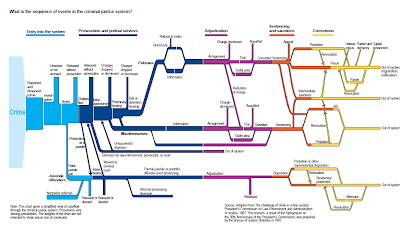
This image can also be viewed at:
http://bjs.ojp.usdoj.gov/content/largechart.cfm
or
http://en.wikipedia.org/wiki/File:Cjsflowco.svg
Without these models, students can read about these rights and freedoms, but might not fully understand the interconnectedness of them. If given the time, one could even add pictures to either concept map, to show examples of each detail. For example, suffrage could be represented by an image of a voting booth while the 4th Amendment might be represented with an image of a police search or warrant.
Models are an excellent way to represent something that is much larger, either in size or in idea, to make it more accessible to the learner. Models help us to think about their original or their muse in a deeper fashion. Finally, we should strive to model more, as modeling is a higher order of thinking and requires the use of observation, spatial understanding, and patterns.
Models of all kinds represent the original object, usually in a way that makes that object more accessible to the viewer/learner. For example, I obviously can't have the Titanic at my disposal any time I would like. It is a massive ship that is at the bottom of the Atlantic. But I can learn more about the Titanic with a model. By looking at a model of the ship I can see what it would have looked like and how the iceberg might have damaged the ship. If I build the model myself, and go one step further, I will have a better understanding of the spatial relationships on board. I would have a better understanding how small a room in steerage was compared to that of someone traveling in first class.
Other models, may not be physical embodiments of the original. In other words, not all models are objects that we can reach out and touch. Sometimes they are diagrams, such as a diagram of an atom. Sometimes they might be virtual, like a flight simulator or a training program for police officers to run through life-like weapons scenarios. Furthermore, they might simply be representational in a more abstract way.
For example, my content area that I have been focusing on over the course of the semester has been rights and freedom. But how do you build a model of somethttp://www.blogger.com/img/blank.gifhing you can not see, touch, taste, or smell? In this case, I created a model of freedom and rights in the United States by using a concept map. A concept map is a model in the sense that it represents the components of the original and helps the learner understand how its parts fit together and how ideas are connected.
To view the concept map as a webpage, click: http://www.gliffy.com/publish/3083436/
The above model shows depicts some of the key components of rights and freedoms in the United States: civil liberties and due process. The concept map then goes on to show the connections to the U.S. constitution. While this concept map does not show all rights and freedoms in the U.S., it does indicate how rights and freedoms are directly related to the Bill of Rights and the subsequent amendments to the constitution. To fully understand due process, I found a concept map that shows the complexities of due process in the judicial system. The diagram below was created by the U.S. Bureau of Statistics and goes a long way to show how complicated this system is:http://www.blogger.com/img/blank.gif

This image can also be viewed at:
http://bjs.ojp.usdoj.gov/content/largechart.cfm
or
http://en.wikipedia.org/wiki/File:Cjsflowco.svg

Without these models, students can read about these rights and freedoms, but might not fully understand the interconnectedness of them. If given the time, one could even add pictures to either concept map, to show examples of each detail. For example, suffrage could be represented by an image of a voting booth while the 4th Amendment might be represented with an image of a police search or warrant.
Models are an excellent way to represent something that is much larger, either in size or in idea, to make it more accessible to the learner. Models help us to think about their original or their muse in a deeper fashion. Finally, we should strive to model more, as modeling is a higher order of thinking and requires the use of observation, spatial understanding, and patterns.
Saturday, October 22, 2011
How Do I Love Thee: Abstracting
Abstracting is the act of taking a complicated subject matter and stripping away all other details to focus on one important characteristic of that subject. In a way, it is asking someone to describe or represent a complicated issue or topic in a simple way. Abstracting can be very difficult. It is a process of looking for only the essential qualities of something as a way to define it or describe it. Try thinking about how to abstract something complicated like justice or beauty. There is an infinite number of ways to abstract justice or beauty. The wonderful part is that there is no wrong answer and no wrong representation. The key to abstraction and the benefit of abstract is the thinking that goes behind it and the learning that occurs as a result of it.
For this series of assignments, I have been focusing on rights. It has also been a topic that we have been discussing quite a bit the last week in my classes. We recently had a student bring a gun to school. As part of the discussion about the incident I had with my students, we talked a lot about rights and freedoms, the importance of those rights and freedoms, when you loose those rights and freedoms, and how those rights and those freedoms are maintained.
When you think about freedom, many ideas will pop into the mind. For Americans, it can be easily abstracted as symbols of freedom in the United States such as the national anthem, The Star Spangled Banner. The Star Spangled Banner actually started as a poem titled Defense of Fort McHenry written by Francis Scott Key, a witness to the British bombardment on Fort McHenry during the War of 1812.

From this famous poem we now have key principles like "land of the free" and "home of the brave". Once it was set to music, the first stanza of the poem became our national anthem, and when played, gives Americans the sense of freedom and pride in that freedom. Here it is played by The U.S. Army Band, under the direction of Colnel L. Bryan Shelburn:
http://www.thenationalanthemproject.org/sounds/Sing%20America%2001.mp3
Some might be interested in a vocal abstraction of the piece:
See more Audio at TeacherTube.com.
Or perhaps you might prefer the Jimi Hendrix abstraction:
Though, maybe fr some, the national anthem does not fully depict the essential aspects of freedom.One cannot fully understand freedom without understanding the lack of it. Therefore, we might think of freedom when we see images of chains and shackles broken and images representing release. All of these images below evoke the strong sense that now that freedom has been obtained, there is now the option of choice.


Freedom can also be abstracted in poetry. Below is an acrostic poem I wrote. I tried to include as many of the essential characteristics of freedom that I could think of. Disclaimer: I do not proclaim it to be good poetry.)
Free to think, say, or do what we choose
Rights that are protected by others
Every person deserves it
Equality for all
Democracy for all
Opportunities for all
Many died to preserve it for us
Perhaps we can abstract freedom in another way by depicting another essential aspect of freedom: its importance. Freedom is so important to us that we celebrate those who serve us to protect that freedom and we lament the loss of those who die for that freedom. Below are pictures my husband, a police officer, took at another officer's funeral who had died in the line of duty. (I wrestled here with which pictures to use. There were some extremely heart wrenching ones that would have had a deeper impact, though I did not want to use them out of respect for this family.) These images and each funeral he has attended over the years reminds the two of us of how precious that freedom is that so many others are willing to risk their lives to protect it.


Finally, to end this on a lighter note, I would like to share one last thing: a video on freedom from The Daily Show with Jon Stewart. This video is a spoof on "Freedom Packages" offered by the United States to other countries uses abstractions. The video itself is an abstraction of infomercials, keeping the key elements of an excited host or announcer with a headset on. Further along we see more abstractions. Notice that Sudan is represented by a bowl of sand; Egypt is represented by the bowl of sand with a pyramid on top; and Iraq is represented by the bowl of sand with oil on top. Not accurate representations, but commentary on how they believe the United States or perhaps Americans view these countries. Finally, the entire video represents the comedians' abstractions on American foreign policy. It strips away all of the complicated details related to foreign relations, revealing a simplistic view on how the United States deals with freedom and rights of citizens in other countries. Political commentary after all is naturally an abstraction that focuses on one important aspect and leaving the complicated details out of the explanation.
Resources:
- Image, Defense of Fort McHenry by Francis Scott Key: http://en.wikipedia.org/wiki/Defense_of_Fort_McHenry
- Star Spangled Banner, as played by the U.S. Army Band under the direction of Colnel L. Bryan Shelburn: http://www.thenationalanthemproject.org/sounds/Sing%20America%2001.mp3
- Vocal of Star Spangled Banner: http://teachertube.com/members/music.php?music_id=6872&title=Star_Spangled_Banner___Full_Performance
- Jimi Hendrix, Star Spangled Banner, http://www.youtube.com/watch?feature=player_embedded&v=L3JbKimTdMg
- Image, Celebrating Our Freedom: http://www.saralandchristians.com/featured/celebrating-freedom/
- Image, Broken egg, http://gargarita.wordpress.com/2008/02/16/libertate/freedom-2/
- Image, Broken handcuffs: http://www.wednesdaynightservice.com/wp-content/uploads/2011/08/Broken_Handcuffs.jpg
- Police Officer Funeral images, used with consent from Michael Jain
- Video, America's Freedom Packages, The Daily Show: http://www.thedailyshow.com/watch/mon-march-21-2011/america-s-freedom-packages

Sunday, September 25, 2011
How Do I Love Thee: Perception – Reflection
Perception is vital to creating understanding. As described by Robert and Michele Robert and Michele Root-Bernstein, “All knowledge begins in observation. We must be able to perceive our world accurately to be able to discern patterns of action, abstract their principles, make analogies between properties of things, create models of behaviors, and innovate fruitfully.” (30) We cannot make connections to the past, to our present, or to our future without observation and perception. Nor can we make connections from one discipline to another. Finally, we cannot foster true understanding without making observations in what we are doing, whether it be performing an experiment or reading a historical document.
A huge challenge that I face with my students in any of my Social Studies classes is reading comprehension, especially of primary documents. Though I have been working with students to improve their comprehension and vocabulary, they spend so much time trying to decipher and decode text, that they miss the important concepts within the text. They don’t take the time or perhaps never even get a chance to observe the connections and the patterns within the reading. Thus, when I started thinking about how the Bill of Rights might be perceived by my students, I started thinking about the important and repeated concepts that they might overlook trying to comprehend the text. In other words, they would be so intent on learning the vocabulary within the text, they might not observe the ideas and concepts that are continually repeated throughout.
That is why I decided to use Wordle to create a visual representation of the Bill of Rights. (There is a link to the Wordle I created in the previous post.)
Wordle generates word clouds from text that the user inputs. The more often a particular word is used in a passage of text, the larger it will appear in the word cloud. For my students that would mean being able to see all of the repeated words and concepts that they might not of observed while they were busy trying to define and understand the vocabulary. Showing this resource to students even just one time can be a valuable tool. Once you realize how often certain words might be used over and over again, you can think about why and what are the different connections to the word or concept within different parts of the text. You can even take it a step further and think about your understanding of the word and how it might be different now that you see how often it is used and how important it is to the document. Students can also be asked to predict what words will be the largest in the word cloud. Even if they are not able to accurately predict which words are the largest, knowing what words they think will be the largest can be a valuable tool for teachers to help assess misconceptions and correct them.
There are many different ways that I could have re-imaged the Bill of Rights. I had thought about creating a video with images that might represent the Bill of Rights. I had even thought of collecting sounds that might be associated with the Bill of Rights. However, I wanted to create something that would have the largest shock factor with my students and something that would connect with their struggles with comprehension. I plan on using it for a writing exercise this upcoming week and look forward to the outcomes.
Saturday, September 24, 2011
< P . E . R . C . E . P . T . I . O . N >
Below is my perception of rights, or more specifically, the Bill of Rights. Click the image to see the larger version on Wordle.

Subscribe to:
Posts (Atom)